Get Started with
Blockdaemon Today!
Contact us to learn how we can help you power your blockchain business.

Unparalleled Security & Compliance
Seamless Integration & Scalability
Dedicated Customer Support

Solana’s 2026 technical roadmap reinforces its position as institutional-grade infrastructure by prioritizing predictable finality, execution integrity, bandwidth and latency improvements, and validator client diversity to support an Internet-native capital market.
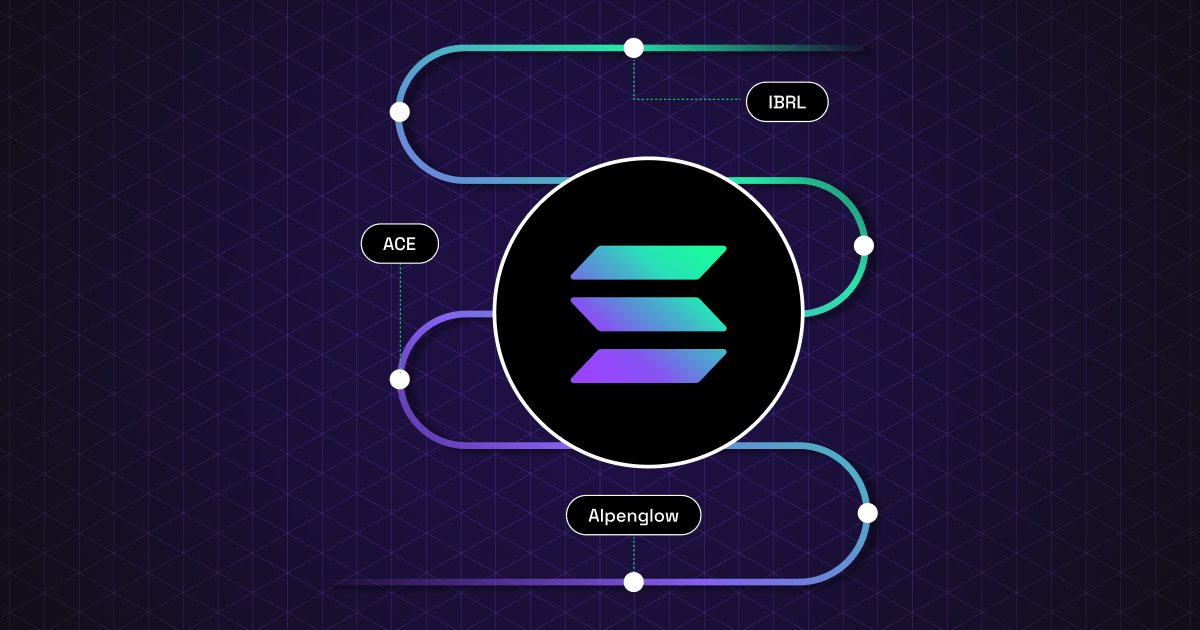
Solana’s 2026 technical roadmap is about hardening the network into something institutions can treat as infrastructure, not just a high‑throughput chain. Rather than chasing headline TPS, the focus shifts to predictable finality, execution integrity, and redundancy.
This blog walks through four pillars of that evolution:
Together, they outline how Solana is positioning itself as a credible backbone for an Internet‑native capital market.
This article is the technical companion to our executive guide Solana in 2026: A Guide for Financial Institutions, which focuses on strategy, use cases and organisational impact.
Alpenglow is Solana’s next consensus protocol upgrade, designed to stabilize block production and synchronization under heavy network conditions.
At the time of writing, Solana combines a proof‑of‑history‑driven leader schedule with a Tower BFT‑style voting system on block “shreds.” Leaders are pre‑assigned slots by stake‑weighted PoH. They produce blocks as shreds. Other validators vote on them, and votes are recorded on‑chain.
Alpenglow is Solana’s next consensus protocol upgrade, designed to stabilize block production and synchronization under heavy network conditions.
These qualities move Solana closer to the operational characteristics of traditional financial infrastructure, where continuity and determinism matter more than theoretical peak throughput.
ACE (Application Controlled Execution) introduces configurability into how applications interact with the network. Instead of relying solely on validators and builders to decide transaction order, applications can influence how their own transactions are processed.
Solana, like many blockchains, is vulnerable to MEV. This is where searchers and validators profit by exploiting pending transactions and block structure.
Even without a traditional public mempool, leader-schedule predictability, local queues, and priority‑fee markets create opportunities for order‑flow exploitation and opaque routing.
Institutions need to demonstrate that their orders were handled in accordance with clear, auditable rules. MEV runs counter to best‑execution obligations and fair‑access expectations.
ACE enables applications to control how their transactions are executed on Solana. Rather than treating execution as purely the validator’s domain, ACE allows programs to define or constrain aspects of ordering, batching, or matching logic with:
For ACE to happen, the Solana ecosystem is reshaping its governance and block‑production models to better align with institutional norms:
These changes reduce concentration risk, improve transparency, and align Solana’s architecture with principles familiar to regulated markets: separation of duties, competition, and auditability.
The evolution toward Application-Controlled Execution (ACE) is already in progress with examples including:
JitoBAM (Block Assembly Marketplace) introduces a modular transaction layer built on top of the Solana blockchain. BAM operates using Trusted Execution Environments (TEEs), which create an encrypted mempool where transactions remain private until execution, reducing exploitative MEV such as sandwich attacks. This separates block construction responsibilities:
The plugin framework enables Application-Controlled Execution (ACE), allowing developers to define custom transaction ordering logic tailored to their specific applications. Use cases include:
ACE’s promise is infrastructure‑level fairness, giving institutional applications predictable, auditable control over how trades, payments, or transactions are realized on‑chain.
Harmonic introduces an open aggregation layer that turns block building into a competitive marketplace rather than a single-source pipeline. It continuously collects and evaluates block proposals from multiple independent builders including Jito, Temporal, JitoBAM, and Paladin, presenting them to validators in real-time for selection.
Validators can continuously choose from multiple block proposals, aligning Solana’s execution path with familiar multi-venue models in traditional markets. For institutions, Harmonic’s model helps address concentration, fairness, and governance concerns that arise when a single client or builder controls most block flow:
IBRL (Increase Bandwidth, Reduce Latency) is the umbrella under which the Solana ecosystem groups bandwidth, scheduler, and latency improvements, including Alpenglow. Its focus is on user‑perceived performance: how quickly transactions are confirmed and how reliably capacity is available during busy market periods.
For institutions, IBRL means transaction times that align with operational SLAs and service‑level expectations comparable to those of traditional financial networks:
To understand how ETH and SOL staking economics evolved over 2025 and what those changes mean for institutions, check out The Blockdaemon 2025 Staking Year-in-Review: Ethereum & Solana.
Multiple independent clients are a key milestone toward system robustness, a familiar concept for banks that rely on multi‑venue market infrastructure.
For leading, network-conscious infrastructure providers like Blockdaemon, client diversity means:
Solana’s evolution over the past two years signals a deliberate shift from experimentation toward institutional usability. This is continuing to gather pace in 2026, with potential real-world benefits for financial institutions, including:
If the “Internet Capital Market” vision succeeds, Solana will be among the first to align crypto‑native performance with the operational discipline of financial infrastructure.
For guidance on prioritising pilots, stakeholder alignment and risk framing around these changes, see the executive guide, Solana in 2026: A Guide for Financial Institutions.


Contact us to learn how we can help you power your blockchain business.