

The stablecoin payments network

Run Validators

Fully managed dedicated infrastructure

Learn more

Access Tempo

RPC endpoints for transactions
and queries

Learn more

Transact Securely

MPC wallets with
policy-based approvals

learn more

Stream Events

Real-time view of
on-chain activity

learn more

Managed Validator Operation

Blockdaemon runs your Tempo validator end-to-end — backed by geo-distributed infrastructure across three global regions.

Four squares that are connected at their center points

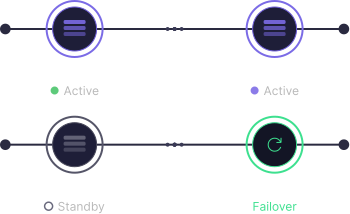
Active-Passive Configuration

A standby node is always ready to take over instantly if the primary fails — eliminating downtime and protecting against missed blocks or slashing events.

White-Label Participation

Participate in the Tempo network under your institution's brand. Blockdaemon operates the infrastructure; your name is on the validator.

A line chart with increasing data

SLA-Backed Monitoring

24/7 automated alerting and on-call incident response with defined RTOs. Performance dashboards and earnings reporting included.

Why Tempo?

Dedicated Payment Lanes

Ensures stablecoin transfers have priority blockspace, maintaining fees at approximately $0.001 even during congestion.

Native Compliance Suite

Features built-in Know-Your-Transaction (KYT) tools, on-chain sanction screening, and ISO 20022 messaging support for seamless bank reconciliation.

Selective Privacy

Offers enterprise-level confidentiality through opt-in privacy features, allowing institutions to protect sensitive data while remaining auditable.

Deterministic Finality

Near-instant confirmation (approx. 0.6s) eliminates counterparty risk and frees "trapped" capital.

FAQs

How does running a Tempo validator differ from running traditional validators?
  • No staking required. Tempo is not yet a proof-of-stake chain. Validators are permissioned — selected and whitelisted by the Tempo team, with a roadmap toward permissionless validation.
  • No native token. Validators earn fees in USD stablecoins.
  • Deterministic sub-second finality. Blocks finalize in ~600ms with no reorg risk and no need to wait for confirmations.
  • Validators currently earn all fees on their proposed blocks. This includes both the fixed base fees and priority gas fees paid by users. Sub-blocks will be implemented at a later date.
  • Built on Reth SDK. The node software is a Rust-based EVM execution client
Is a stake mechanism involved in running a Tempo validator?
  • No, Tempo is not a proof-of-stake blockchain currently, so there is no staking requirement.
Is there documentation and materials to explain the validator process?
What is the proposed revenue-share model as the primary commercial option, given the lack of concrete transaction volume numbers?
  • Tempo does not currently share commercials with partners for their validators. For whitelabeled validator operators supporting partners, recommended commercial structure is either fixed fees or percentage revenue sharing. Ultimately, the validator operator and partner should agree on commercial structure directly.
What factors will influence validator selection?
  • Validator order for proposing blocks is random currently.
How will transaction routing be determined among the validators?
  • Currently, transactions are freely shared in the mempool, and the validator proposing can select any available transaction.
  • Tempo is working on a novel feature called subblocks, where a validator has reserved block space as a portion of every block, not just the ones they propose.Validators can use the space to propose and earn fees from their own transactions, without sharing them in the mempool.
What stablecoins will be used for validation payouts?
  • Currently, validators use pathUSD only. Validators can set their preferred payout token for fees and may have preferences for other stablecoins for Tempo mainnet launch.

Choose Blockdaemon for Resilience and Simplicity.

Audit-Ready Compliance: ISO 27001, SOC 1 Type 1, and SOC 2 Type II certified.
Operational Abstraction: Full-lifecycle managed automation 
Systemic Reliability: Payment-grade uptime across 60+ protocols with $10B+ assets under management.
De-Risked Custody: MPC-protected architecture eliminates single points of failure.


Get Started with
Tempo Today!

As an early infrastructure partner for Tempo, we provide the scale and security required for the next generation of digital finance.